

t: 07951 379 857
  • Home
  • About
  • Why Legacy?
  • Instructors Bio
  • Book
  • News
  • Contact
  • Home
  • About
  • Why Legacy?
  • Instructors Bio
  • Book
  • News
  • Contact
Search

BLOG - Learn with Legacy - Finding Vibrato

5/12/2021

0 Comments


BLOG
Learn with Legacy
Finding Vibrato


Welcome to our May Blog 

So you’ve found a good vocal balance and mix what next?

You’re feeling a good chest voice, you have discovered head voice and you blend them pretty well ascending and deciding what now?
The next step in your vocal development will be to test dynamics, stamina and agility in the whole range. Can you sustain notes, do you have vibrato? How balanced are you on riffs and runs? How is your volume control? How are you in faster tempo songs? Can you do all of these things on vowels without the aid of consonants or unfinished sounds? We will be exploring all these concepts over the next few months. But we will begin with vibrato. 

What is vibrato?

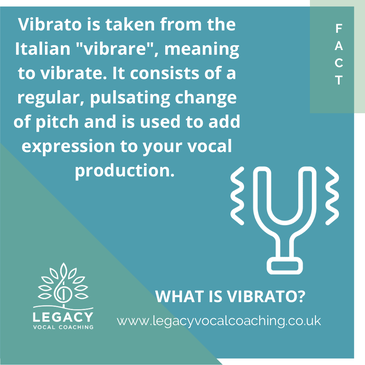
Vibrato is taken from the Italian "vibrare", meaning to vibrate. It consists of a regular, pulsating change of pitch and is used to add expression to your vocal production. Vibrato is typically characterised in terms of two factors: the amount of pitch variation ("extent of vibrato") and the speed with which the pitch is varied ("rate of vibrato"). In singing it can occur spontaneously through variations in the larynx if we are in vocal balance. 

​
Picture
Picture


​
​How is this achieved?

All human voices can produce vibrato and it can vary through training and styles of music. There are different voice vibrato processes that occur in different parts of the vocal tract. A combination of the vocalis muscles vibrating and the diaphragm vibrating at two separate but similar frequencies results in a vibrato. 

How do we do it?

We can mimic vibrato in the larynx with bleating sounds like a sheep but to add in the second frequency using the diaphragm we can try sounds like chimpanzee noises or laughing. There are many ways to experience the mechanism for vibrato and not everyone will be the same. We can manufacture it or it can occur more naturally when we are in vocal balance but these are all good ways to get us starting to feel the muscular functions that create vibrato in your voice. 

Look out for our YouTube video on our channel to see some examples for you to try out for yourself.

​


0 Comments


Leave a Reply.

    Picture

    Author 

    Donna is the founder of LVC

    RSS Feed

Postal Address

One Express
1 George Leigh Street
Manchester M4 5D

What  Legacy Clients Think

  "Legacy really really cared about what I wanted from the lessons and it felt like they had chosen to invest in my dreams." - Rosie Robinson
"I have the confidence that comes from knowing that I can do it - and that the world doesn't end when I make a mistake!” - Rachael Smith

Picture
Picture

Contact Us

[email protected]
07951 379 857
Terms of Use
Frequently Asked Questions
Book
© COPYRIGHT 2025. ALL RIGHTS RESERVED.
  • Home
  • About
  • Why Legacy?
  • Instructors Bio
  • Book
  • News
  • Contact